Two Creative Strategists on Turning Insight Into Impact
12 Aug 2026
 Search


 All Publicis Groupe Romania proprietary data tools in one place.


In advertising, data is often seen as the rational counterpart to creativity. Yet for strategists working at the intersection of brands, people, and communication, data is rarely about numbers alone.
We spoke with Miruna Antonescu – Head of Strategy and Laurențiu Semeniuc – Product Growth Lead from Saatchi & Saatchi, about how data influences creative thinking, what makes an insight truly valuable, and why the future of communication will depend as much on human curiosity as on technology.
Ask Laurențiu what he does for a living, and he calls himself a translator between people and brands, using data and know-how to understand what both sides want, then finding the common ground that relevant creativity can build on.
Miruna puts it simply: her job is to make ads people don’t skip😊. That means anchoring every campaign in a human truth people recognize, one that says something relevant and convincing about the product behind it.
Turning numbers into ideas is less science than persistence. Miruna starts from a fundamental place: you actually have to enjoy looking at data. From there, the real skill is navigating the sheer volume now available and picking out exactly what’s usable for the problem at hand.
Laurențiu borrows a line from a fellow professional: you have to “torture the data until it confesses”: know what to look for, where, and how, and you’ll surface things about consumers or brands worth building a campaign around. The catch is that there’s rarely enough time to do that research properly.
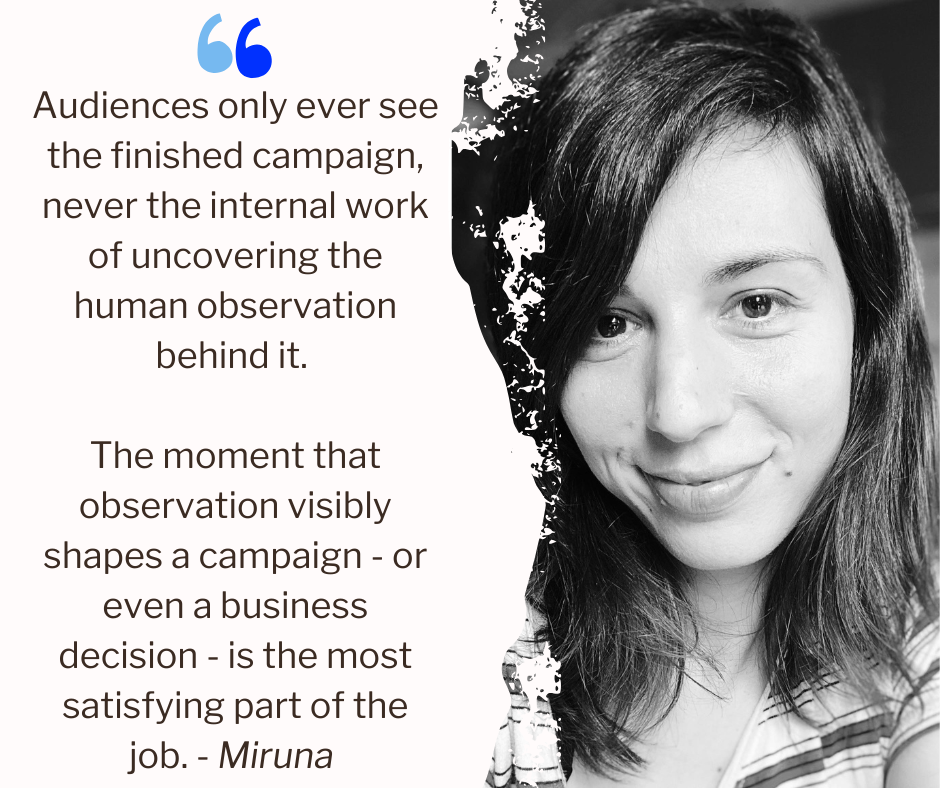
What excites Laurențiu most is twofold: finding a genuine insight, and then finding the creative idea that puts it to work. Real insights, the ones that show you something about people you didn’t know you knew, are rare, he says, pure gold you have to know how to recognize and protect. Getting there, though, is often more tortuous than thrilling.
Both have been caught out by their own research. Laurențiu points to how often data contradicts what’s actually happening in the market – a mix of methodology, sampling, and human bias. He likes to cite David Ogilvy’s warning about the limits of research: people don’t think what they feel, don’t say what they think, and don’t do what they say. His takeaway: treat data as a useful tool, not an absolute truth – necessary, like a scalpel, but not sufficient for every problem.
Miruna’s version of the same lesson: the most valuable moment isn’t when data answers your question, but when it changes your question entirely: that’s what opens the door to ideas nobody saw coming.
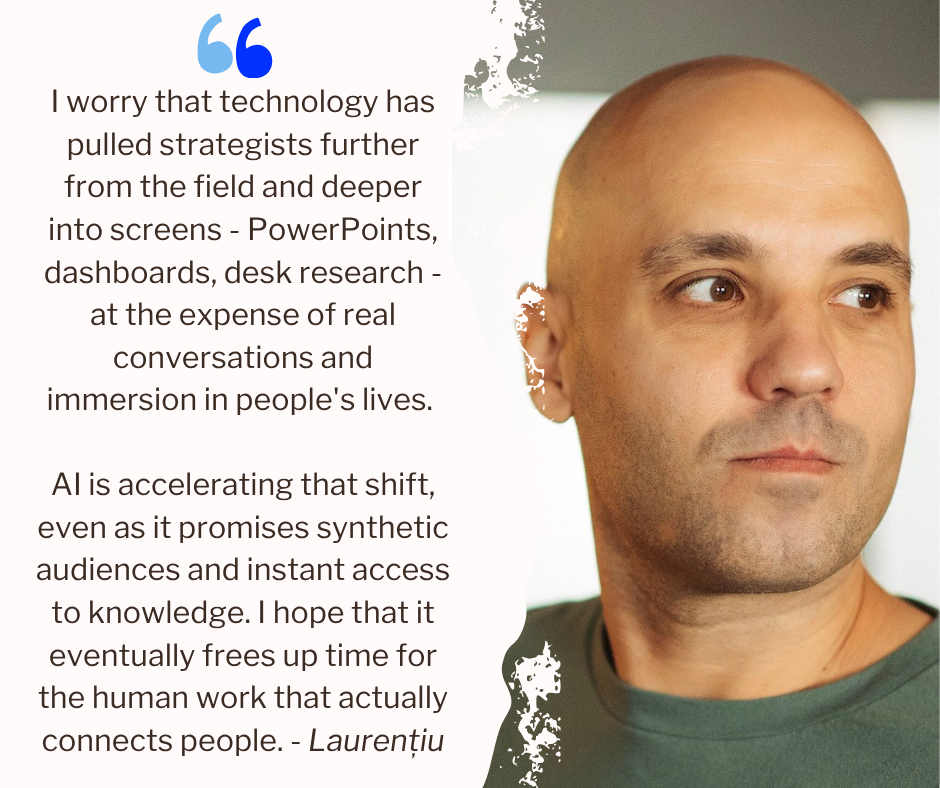
Miruna frames the same shift differently: fifteen years ago the industry complained about not having enough data; now it has too much, AI included. That’s exactly why strategy matters more, not less – the more information there is, the more someone needs to separate signal from noise. Used to sharpen thinking rather than replace it, she says, AI is a net gain.
Laurențiu is adamant that strategy is still, and should remain, mostly about intuition – data helps confirm, sharpen, or challenge it, not replace it. The myth he’d retire: that creative work can’t happen without data. It can, he says, and sometimes it’s even better that way. But it really depends; it varies from case to case.
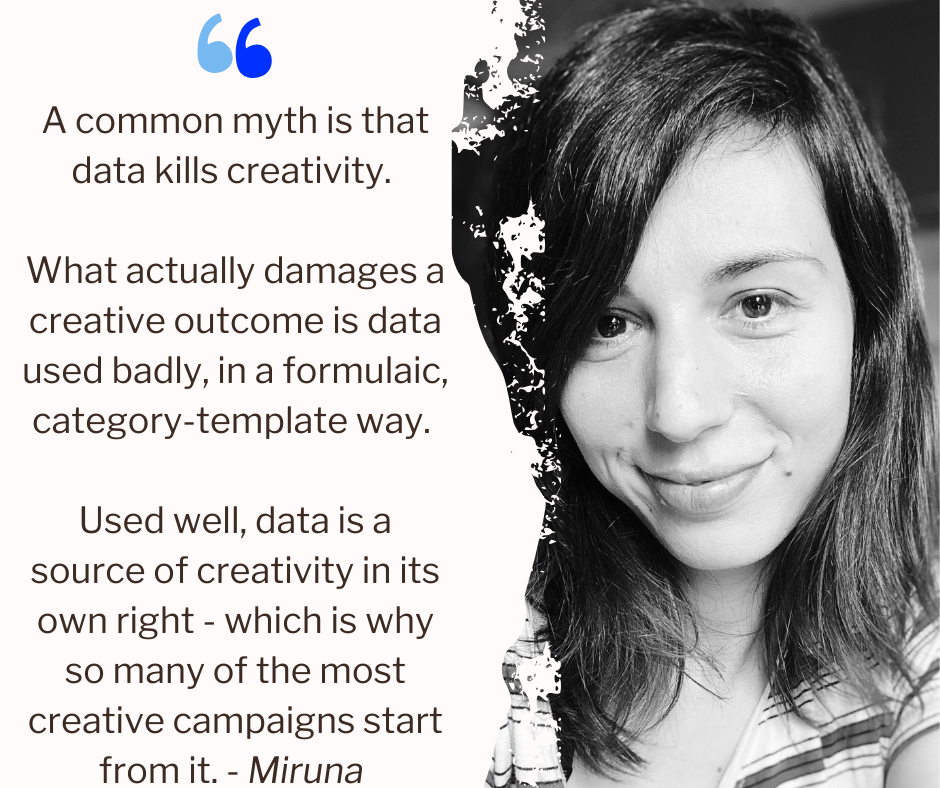
Miruna’s pitch to a young strategist is about the job’s built-in permission to stay curious: constantly learning from data, from a fast-changing industry, from the sheer range of categories you touch – one of the few careers where curiosity is, literally, the job.
For Laurențiu, the strategy-creativity-data combination is what makes this industry worth entering: the same skillset used for commercial impact can, if you choose, drive cultural, social, or economic impact elsewhere too. What first drew him in was simpler – the fascination of seeing ads on TV that millions of people would watch, laugh at, and remember.
Laurențiu disconnects by getting outside – increasingly rare, he admits – walking, cycling, listening to music, reading. Staying curious about the people around him, he says, is part of what keeps his creativity alive.
Miruna’s version: understanding why disconnecting matters is what makes it work. Real time off – no notifications, bike rides, adventures with the kids, reading – is, for her, the actual mechanism that keeps a creative mind healthy.
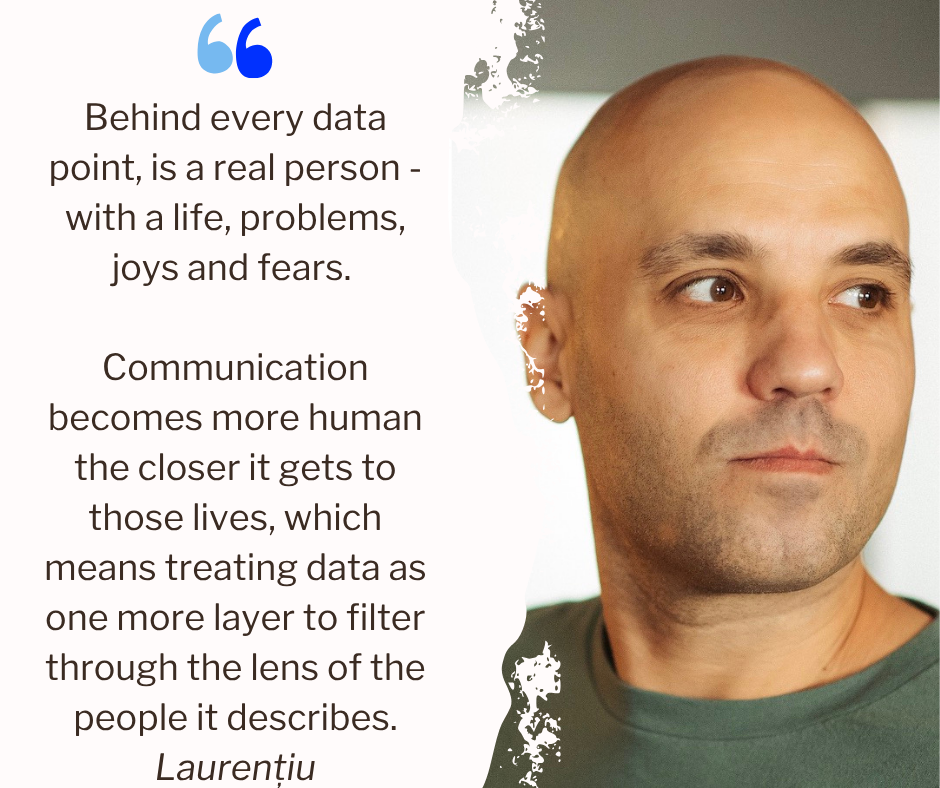
Miruna puts the same idea simply: data is never separate from reality, it’s always about people. Ask “why” after every statistic, and there will always be something human behind the numbers in a spreadsheet or a slide.
All Publicis Groupe Romania proprietary data tools in one place.