Beyond K-pop: how Asian culture quietly became part of everyday life in Romania – Starcom Romania Study
27 Oct 2026
 Search


 All Publicis Groupe Romania proprietary data tools in one place.


Ask most marketers what “Asian culture” means for Romanian consumers and you’ll hear the same three words: K-pop, anime, fandom. It’s a tidy picture of teenagers, merchandise and screaming crowds. According to new data from Starcom Romania, it’s also mostly wrong.
“The results show that the opportunity for brands extends far beyond highly engaged fans. There is a broader audience drawn to discovery, entertainment, value, and new experiences. To turn this curiosity into lasting relevance, brands need to combine accessibility with a genuine understanding of the cultural context and the communities they aim to connect with,” said Mirela Mirica, Media Research Specialist.
For many Romanian consumers, Asian influences are not necessarily a defining part of their identity. They are a way to discover another culture, relax, enjoy different stories or try something new. Thirty-one percent primarily associate these influences with discovering new cultures and perspectives, while 20% connect them with relaxation and entertainment. Only 5% describe them as an important part of their self-expression.
This distinction is strategically important. Brands do not need to speak only to dedicated fans. There is also a substantial audience of curious, occasional consumers who can be reached through accessible experiences and familiar categories.
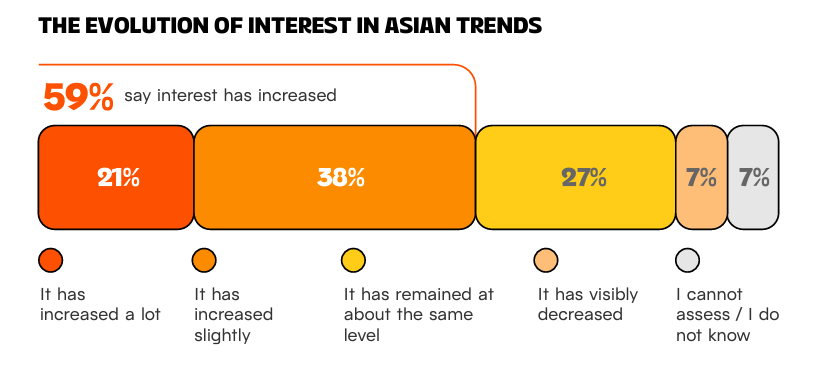
YouTube and TikTok are the primary channels through which consumers discover Asian trends. But digital discovery frequently leads to real-world behavior.
Asian food is the most common next step after exposure to Asian influences, followed by watching Asian films and Korean series. Beauty products, anime, language learning and Asian-inspired fashion create additional pathways, especially among younger consumers. This suggests a broader role for media than simply building awareness:
Not all categories offer the same route into this universe.
Food has the broadest and most familiar appeal. It is both an accessible introduction and a repeat consumption occasion. Consumers combine familiar dishes such as sushi, noodles and rice with the desire to explore something new. Personal recommendations lead restaurant discovery overall, while TikTok plays a particularly important role for younger consumers.
Beauty follows a somewhat different path. Asian personal care products are already present in many routines, but adoption tends to be selective: consumers may use them occasionally or for particular skincare steps rather than switch their entire routine. Value for money is the leading appeal, followed by ingredients, textures, innovation and visible results.
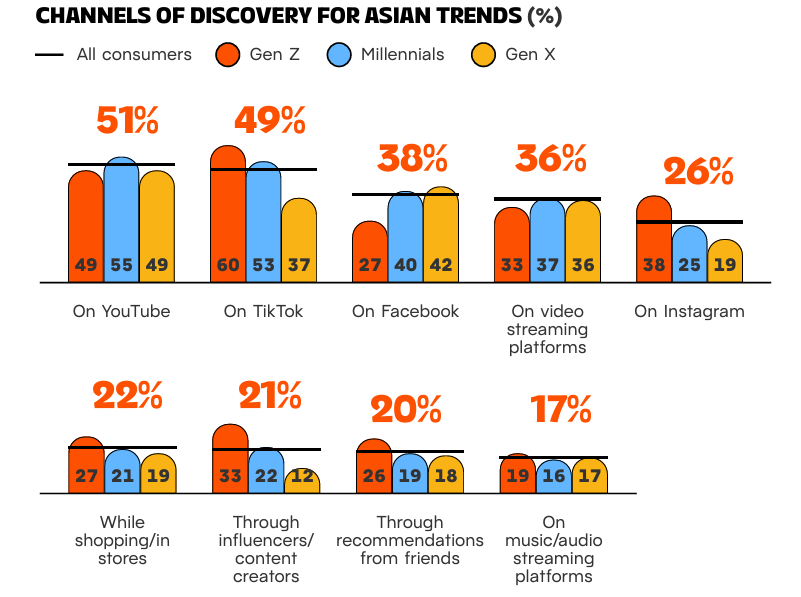
Generational differences are meaningful, but they should not be reduced to the assumption that Asian culture belongs exclusively to Gen Z.
Gen Z leads many forms of active engagement and is more connected to anime, manga, fandoms, influencers and Asian-inspired self-expression. Millennials stand out in several established consumption behaviors, including music, beauty and frequent food consumption. Gen X is less active in fandom environments but shows strong interest in food, films and cultural discovery.
The opportunity is not to create one campaign with small generational adjustments. It is to recognize that different generations may arrive at the same cultural universe through entirely different doors.
Interest does not automatically translate into deeper engagement.
Lack of time is the most frequently mentioned barrier to exploring Asian culture further. Availability, cost, difficulty finding suitable content and uncertainty about where to begin also create friction.
The same principle applies to commerce. Romanian consumers generally prefer local purchasing channels because they offer simplicity, safety, faster delivery and lower costs. International sources remain attractive mainly because of their wider product variety.
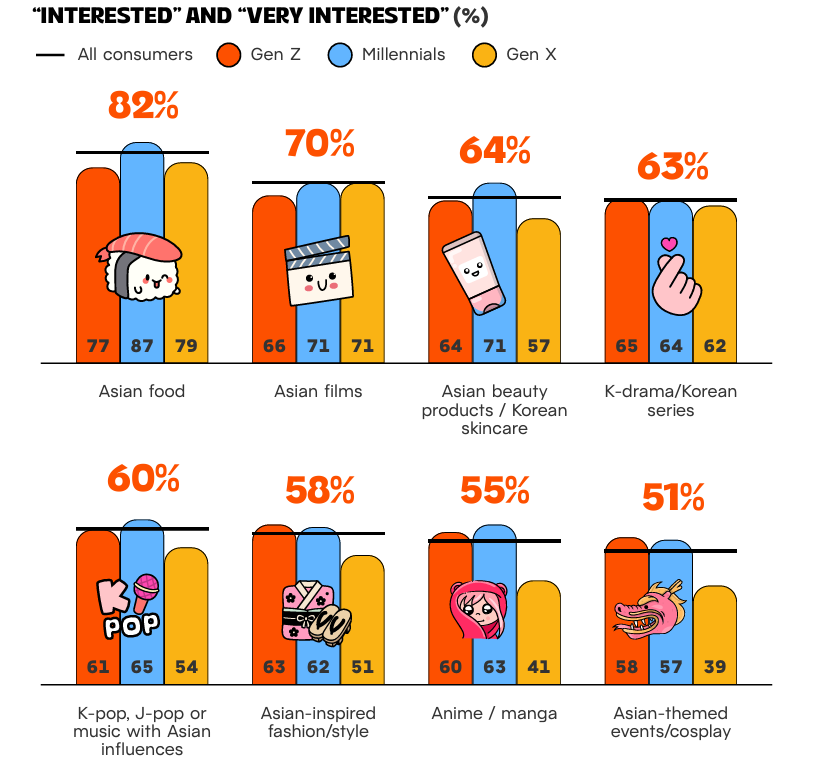
Asian pop culture offers brands a rich visual vocabulary. But using recognizable colors, symbols or popular references is not enough.
When asked what makes a brand association with Asian influences feel authentic, consumers’ leading expectation is that the brand should understand the culture and community, rather than simply use its aesthetics. Limited-edition products, collaborations with relevant artists or creators, support for local communities and interactive experiences can strengthen an association, but only when they are built on cultural understanding.
Cultural relevance cannot be added as a design layer at the end of a campaign. It has to shape the concept, partnerships, product and experience from the beginning.
From attention to sustainable relevance – Asian culture is becoming more visible in Romania, yet it is not experienced in the same way by everyone. For some consumers, it is a deep community connection. For many others, it is a meal, a film, a skincare product or a new source of inspiration.
The short version of “Asian culture and the Romanian consumer” is available below. For more insights, contact consumer@starcomww.com. The study explores in-depth how consumers engage with Asian culture, and it covers key areas including music, entertainment content, beauty routines, food habits, fandom communities, and the impact of Asian trends on shopping behaviors and brand opportunities.


Methodology
The study was conducted by the media agency Starcom Romania through online questionnaire-based interviews (CAWI) with 803 respondents, both female and male, aged 18 and over, during September 2026.
About HumanGraph Experience
HumanGraph Experience is an infographic series based on quantitative research that analyzes the characteristics of target groups in relation to specific product categories (such as sweets, beer, or luxury goods), particular occasions (like Easter, Christmas, or Black Friday), or emerging communication phenomena (for example, influencer marketing or technology adoption).
All Publicis Groupe Romania proprietary data tools in one place.