What women expect from tech in the age of AI
15 Apr 2026
 Search


 All Publicis Groupe Romania proprietary data tools in one place.


For a long time, technology was not really “a thing” for women, at least not in the way brands chose to portray it. It was either background infrastructure, or a category communicated through a narrow lens: functional, technical, and often disconnected from how women actually live, decide, and express themselves.
In the age of AI, smart devices, and connected ecosystems, technology is no longer peripheral. It sits at the center of everyday life, shaping how we communicate, present ourselves, make decisions, and navigate the world.
And when you look at it through this lens, women’s perspectives become essential. Insights from the 2026 study reveals not just how women relate to technology today, but what they expect from it going forward.
And the answer is clear: not perfection. Control.
One of the most striking shifts is where confidence actually lives. Women today feel capable. They trust their decisions, their judgment, their ability to handle both everyday challenges and complex situations. Confidence, in that sense, is not missing.
But when it comes to appearance and self-representation, things become more nuanced. There’s a hesitation there, a sense that while I know who I am, I’m not always fully comfortable with how that translates outward.
And this is where technology quietly plays a role. Because every camera, every editing tool, every interface becomes part of that translation process.
For brands, this creates a new responsibility – the goal is no longer to help users “look better.” It’s to help them feel in control of how they present themselves. That’s a very different promise.

There’s been a lot of talk about authenticity in recent years. The assumption is often that people want things to be raw, unfiltered, completely real.
But that’s not quite true. Women are not rejecting enhancement. They’re rejecting lack of control over enhancement. Most are navigating a middle ground:
What they’re really asking for is something more precise: controlled authenticity.
And this is where technology brands have a clear role to play. The tools themselves are not the problem. In fact, they’re expected. But how those tools are positioned matters. Are they there to “fix” something? Or are they there to give users choice?
The difference defines whether a product feels empowering, or quietly prescriptive.
Nowhere is this tension more visible than in the way women respond to artificial intelligence. There is openness, curiosity, even excitement, but it comes with conditions.
AI is welcomed when it helps people do something tangible: visualize a product, simulate a decision, simplify a complex choice, personalize an experience.
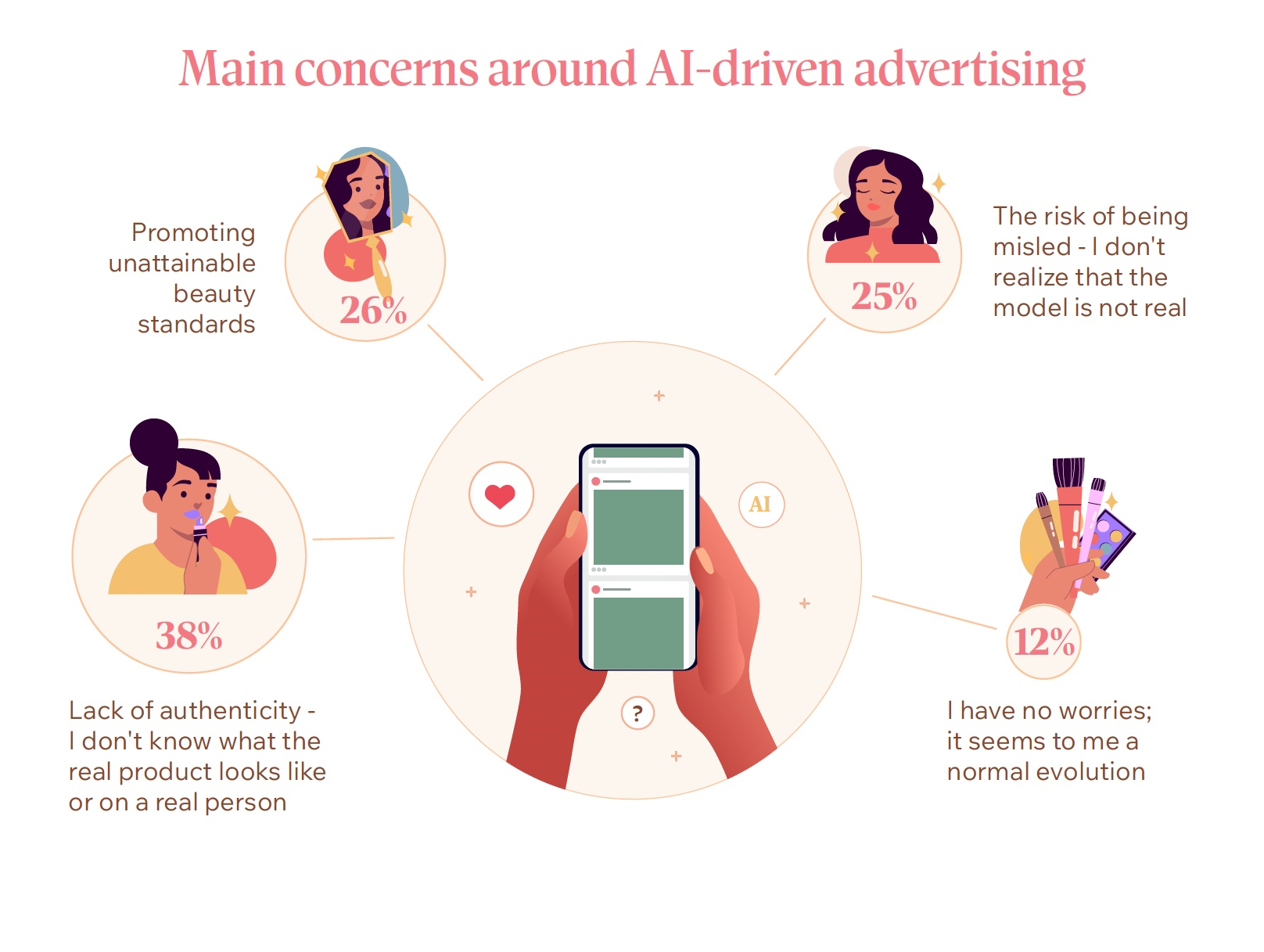
In other words, when it acts as an assistant. But the moment AI shifts into creating idealized versions of reality – perfect faces, perfect scenes, perfect lives – trust starts to erode, because it reintroduces the very pressure women are trying to move away from. What stands out is the clarity of this boundary:
For technology brands, this could be a direction: innovation should focus less on illusion, and more on usefulness. Less on spectacle, more on everyday value.
And above all, it requires transparency. Because when users understand what AI is doing, and why, they’re far more likely to embrace it.
There’s another shift happening, and it’s easy to overlook.
Women are no longer satisfied being portrayed as passive users of technology. They don’t want to be shown “figuring it out.” They expect to be seen as already competent. As people who:
This expectation goes beyond representation. It touches product design, communication, and overall brand positioning. Because when confidence is rooted in autonomy, the role of technology changes.
Put all of this together, and a new definition of innovation starts to emerge.
It’s not about adding more features, but more about creating experiences that give users control over how they show up, respect their ability to decide, offer real, functional value, and avoid reinforcing unrealistic standards.
In short, innovation becomes less about what technology can do, and more about what it allows people to do on their own terms.
Women in 2026 are not rejecting technology.
They are setting new expectations for it: they want tools that are powerful, but not over-powering, smart, but not intrusive, advanced, but still human.
All Publicis Groupe Romania proprietary data tools in one place.