Digital Marketing Forum Romania 2026: Key takeaways
11 May 2026
 Search


 All Publicis Groupe Romania proprietary data tools in one place.


Romania’s largest digital marketing conference, held last week, brought together marketers, brand strategists, and technology leaders for two days of insight-packed sessions. Here is a synthesis of the ideas that mattered most.
This year’s edition felt honest in a way that was refreshing. Alongside impressive campaign results and new technology showcases, speakers were equally willing to admit what they don’t yet know, and why that matters. The recurring anchor of almost every conversation was AI: its promises, its limits, and the very real gap between experimenting with it and making it work.
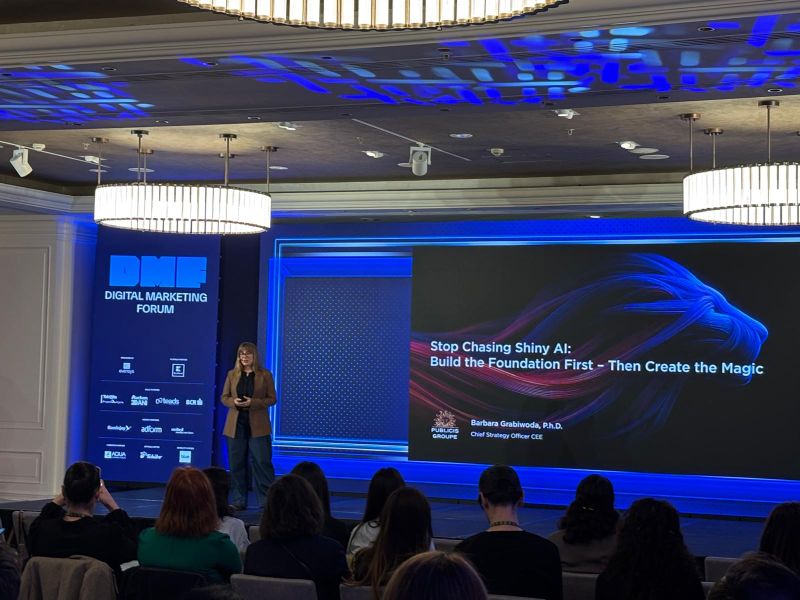
Barbara Grabiwoda, Chief Strategy Officer at Publicis Groupe CEE, opened with what was perhaps the most grounding message of the day: stop chasing shiny AI and build the infrastructure first. Most organisations, she argued, are pursuing AI experimentation before they have the operational conditions to make it stick, and the result is a gap between impressive demos and real business impact. Closing that gap means doing the unglamorous work first: establishing a clear ethical position on AI use, putting governance and risk frameworks in place, identifying where AI actually creates value (connected identity, intelligent content, CRM), and ensuring the right skills, data quality, and tools are in place to enable adoption.
The strategic point is that without these foundations, AI investment produces noise rather than results. And the human point, equally important, is that meaningful brands are still built by people. Creativity, emotion, and human-led thinking are not things to be outsourced to algorithms.
AI is impressive and scary at the same time. That phrase, spoken during the senior panel, resonated across the room. Marketers are genuinely excited about the speed and options AI unlocks, but anxiety about automation, job displacement, and brand identity erosion runs just as deep.
The panel was notably candid: “I don’t know” was framed not as a weakness but as intellectual honesty. The most useful analogy of the day came here too, AI is like an autopilot: capable of handling a great deal, but no plane takes off without a pilot. AI will accelerate the gap between those with expertise and those without, which makes investing in knowledge and skills more urgent, not less.
AI-driven campaigns have proven effective for conversion-focused, functional goals – eMAG’s experience confirmed this clearly. But for brand-building and new product launches, human emotion still wins. The concern that surfaced repeatedly: in a world where AI can generate content at scale, brands risk losing their distinctiveness. The counterweight is authenticity – using AI as a tool while protecting the creative identity and voice that make a brand recognisable.
Teads, Auchan, and Kaufland all brought evidence that consumer attention is more fragmented than ever. Streaming TV is overtaking linear TV; every screen is a connected device. Brands that can’t connect their data across touch-points are leaving measurable results on the table.
Connected media and retail media emerged as high-opportunity areas, and the principle was simple: data tells us what we lose when we don’t act across channels.
CRM performance was a bright spot for multiple brands, but panelists were frank that getting consumers to share data willingly is an ongoing challenge requiring trust, not just technology. The quality of data feeding AI models is ultimately what determines the quality of the output.
The masterclass held by our colleague Rodica Mihalache – Data Intelligence Lead, addressed one of the most consequential shifts in digital marketing today. The old question “where do I rank on Google?” has been replaced by a more demanding one: “does AI understand me well enough to recommend me when a consumer is making a decision?” AI tools are now where millions of people go first for advice, comparisons, and recommendations.
They don’t browse a list of links, they ask a question and receive a synthesized answer. If a brand isn’t present, cited, or understood in those answers, it simply doesn’t exist at that moment. This is what Generative Engine Optimization (GEO) addresses:
Classic SEO is no longer enough on its own. Visibility in 2026 is about being chosen.
The consensus: AI will become like the internet – omnipresent but unremarkable, something we use without thinking about. What will define the next decade is not the technology itself but how we use it: with judgment, creativity, and a clear sense of what makes us human.
Digital Marketing Forum Romania returns next year. In the meantime, the conversation about AI, identity, and what makes brands matter continues, perhaps more urgently than ever.
All Publicis Groupe Romania proprietary data tools in one place.