Focus On – The Rebalancing in Media Adoption – Spark Foundry Romania Study
27 Jul 2026
 Search


 All Publicis Groupe Romania proprietary data tools in one place.


Every new wave of media research promises a revolution. Someone will always tell you TV is dead, search is over, or the metaverse is about to eat the internet. The 11th wave of Spark Foundry Romania’s Focus On: Romanians’ New Media Adoption study reveals a more nuanced reality: media habits are not collapsing, they are realigning.
“We are seeing a shift in digital behavior, with some entertainment and social activities continuing to moderate, while more practical online behaviors show signs of selective recovery. Information search and online payments remain among the most common digital activities, and users are increasingly integrating AI-based solutions into the way they access information and interact with the digital world.
At the same time, we are witnessing a more mature relationship between users and artificial intelligence. While AI was initially associated mainly with access to information, its use is now expanding across a broader range of everyday needs and situations. Whether for learning and professional development, health, or choosing products and services, users are incorporating AI into more aspects of their daily lives. The strong adoption of tools such as ChatGPT, Gemini, Google AI Mode and Copilot, together with the fact that nearly half of urban internet users already rely on AI during the purchase journey, shows that this technology is becoming an increasingly important part of everyday digital life.” stated Mădălina Bâdea, Head of Data Insights, Spark Foundry.
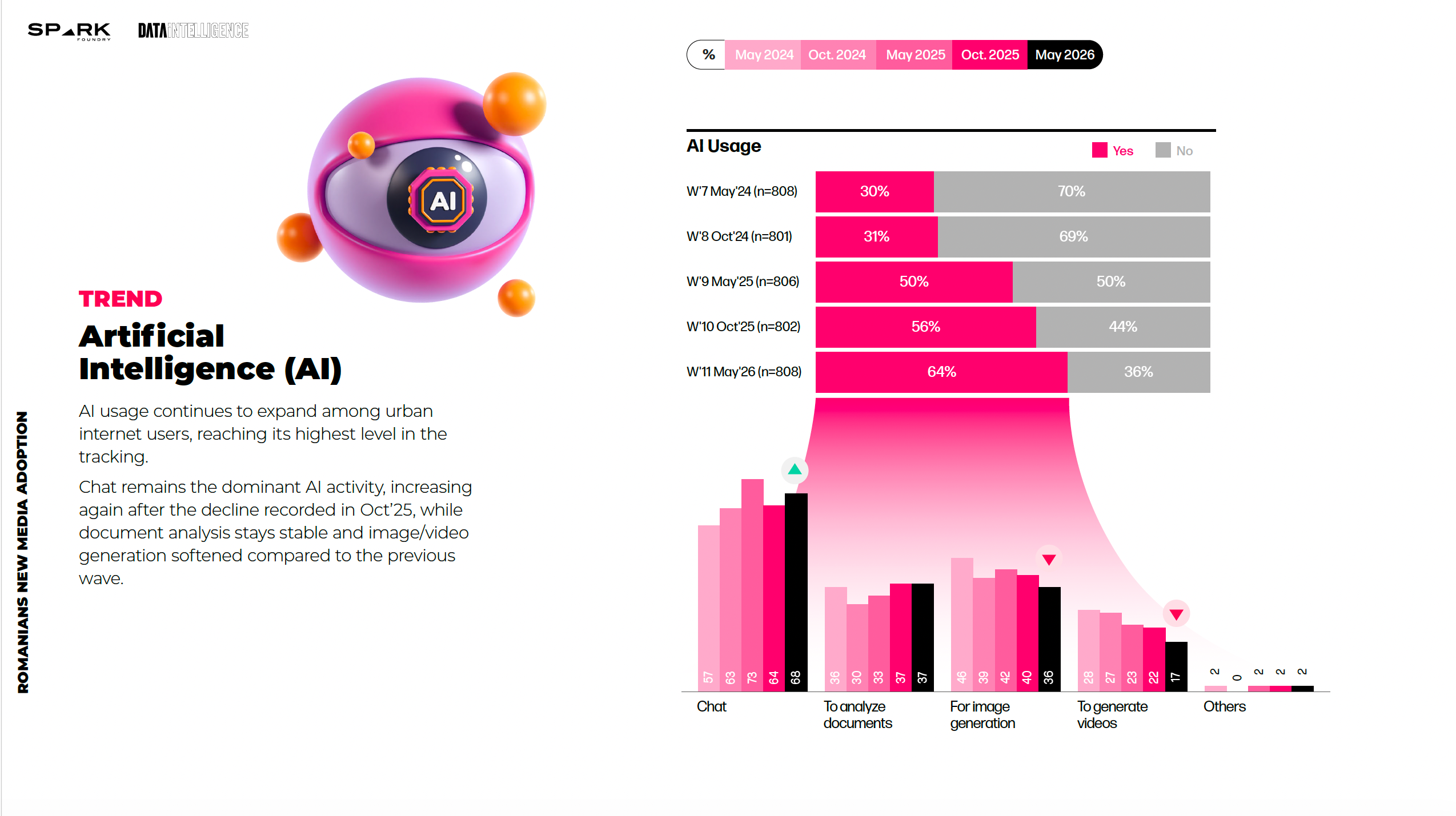
Sixty-four percent of urban internet users now say they use AI tools – up from 56% just six months ago and more than double the 30% recorded a year ago. That’s not gradual adoption anymore, that’s a curve. Chat remains the dominant use case, but the more interesting number sits inside the search data: AI-assisted search now shows up at 26% of the information-seeking journey, appearing for the first time as its own category alongside text, image and voice search.
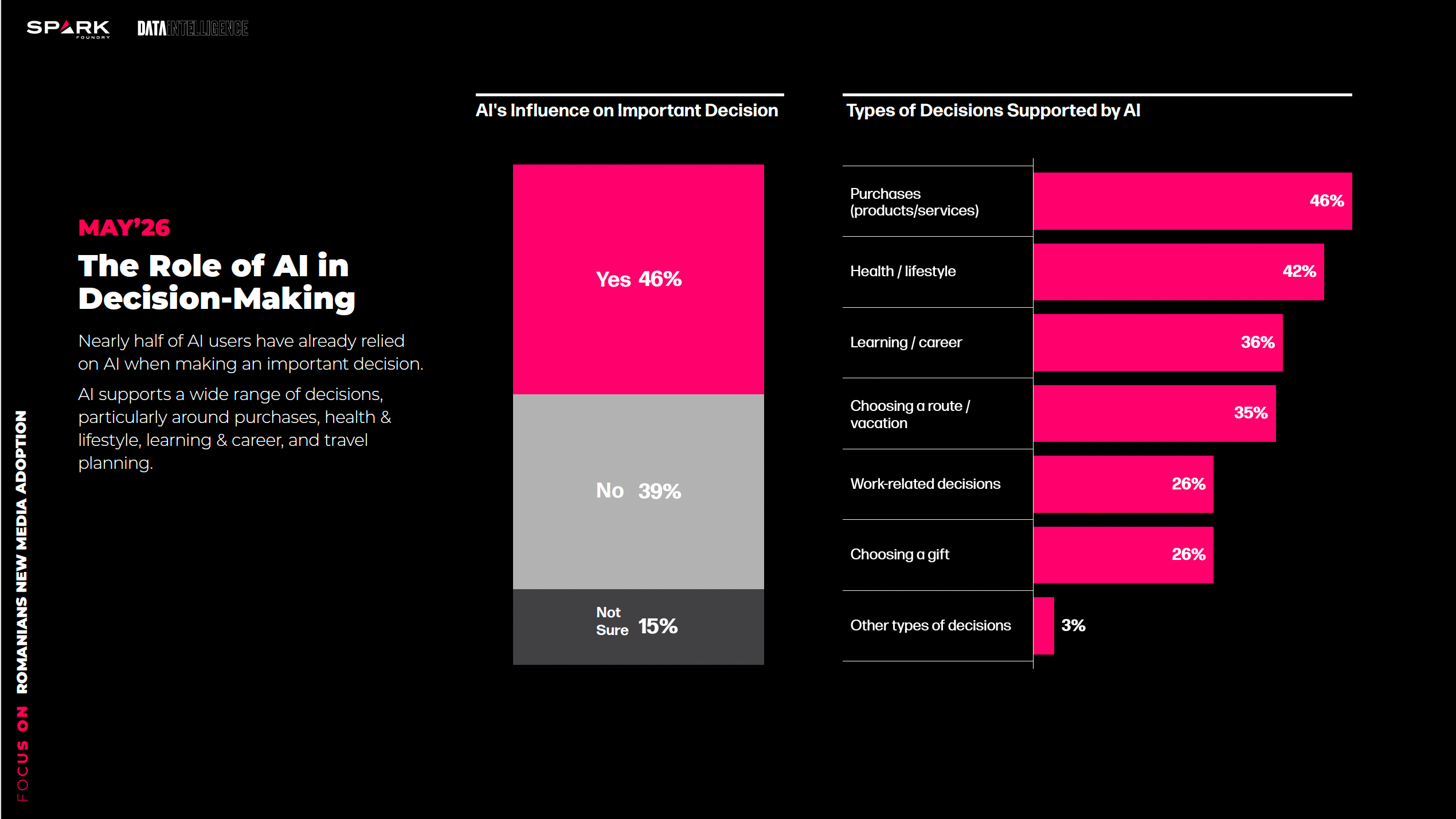
It’s already shaping decisions people care about. Roughly 46% of AI users say they’ve relied on it for an important choice – purchases lead, followed closely by health and lifestyle decisions, learning, and travel planning. Speed and relevance are why people reach for it over search or social: it filters out noise and gives them something closer to a direct answer.
What tempers the hype: only 7% currently pay for AI, and 39% say they wouldn’t. But a third say it depends entirely on the benefits offered – which is really the whole story of AI adoption in one line. People aren’t loyal to AI as a category. They’re loyal to whichever tool answers the question fastest and best. That’s a genuinely different battleground than the one search marketing was built for.
Preference for classic text search dropped to 56% in this wave- its lowest point since tracking began, down from 73% just two waves ago. That’s a steep enough decline that it’s worth sitting with. But it hasn’t been replaced by any single alternative; it’s been split across image search, voice, AI chat, and direct searches on TikTok and Instagram, each holding a modest and fairly stable share.
The generational split is the part worth planning around. Users 45 and older are still anchored to text search – for them, the search box hasn’t really changed. Under-34s are already blending five or six discovery methods without thinking about it as a shift at all. If your content strategy is still optimized for a single search box, you’re increasingly optimizing for half your audience.
For years, the assumption behind cross-channel campaigns was simple: a TV ad runs, people pick up their phones, they search or shop. That handoff is fraying. Only 40% of viewers now say they go online exclusively during commercial breaks – the lowest level recorded across all eleven waves. And only 39% say a TV ad has prompted them to look up a product online, also a new low.
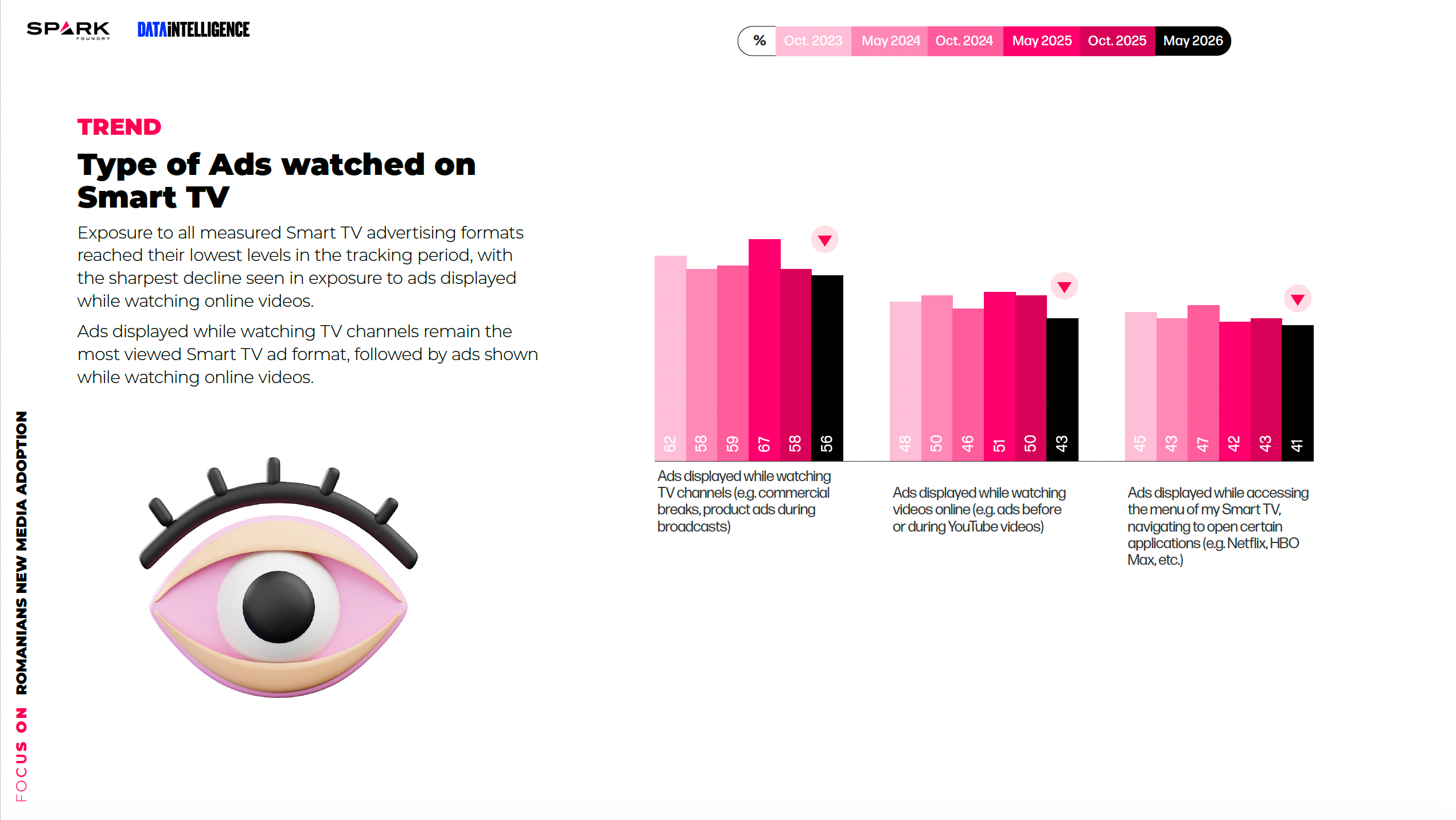
TV itself isn’t disappearing – Smart TV ownership just hit a record 91%, and combined TV-plus-online viewing is still the most common way people watch. What’s weakening is the link between the TV moment and the online action that used to follow it. If your media plan still treats TV exposure as a reliable trigger for digital response, this wave suggests that assumption needs a second look – the awareness may still be landing, but the immediate behavioral follow-through is not what it used to be.
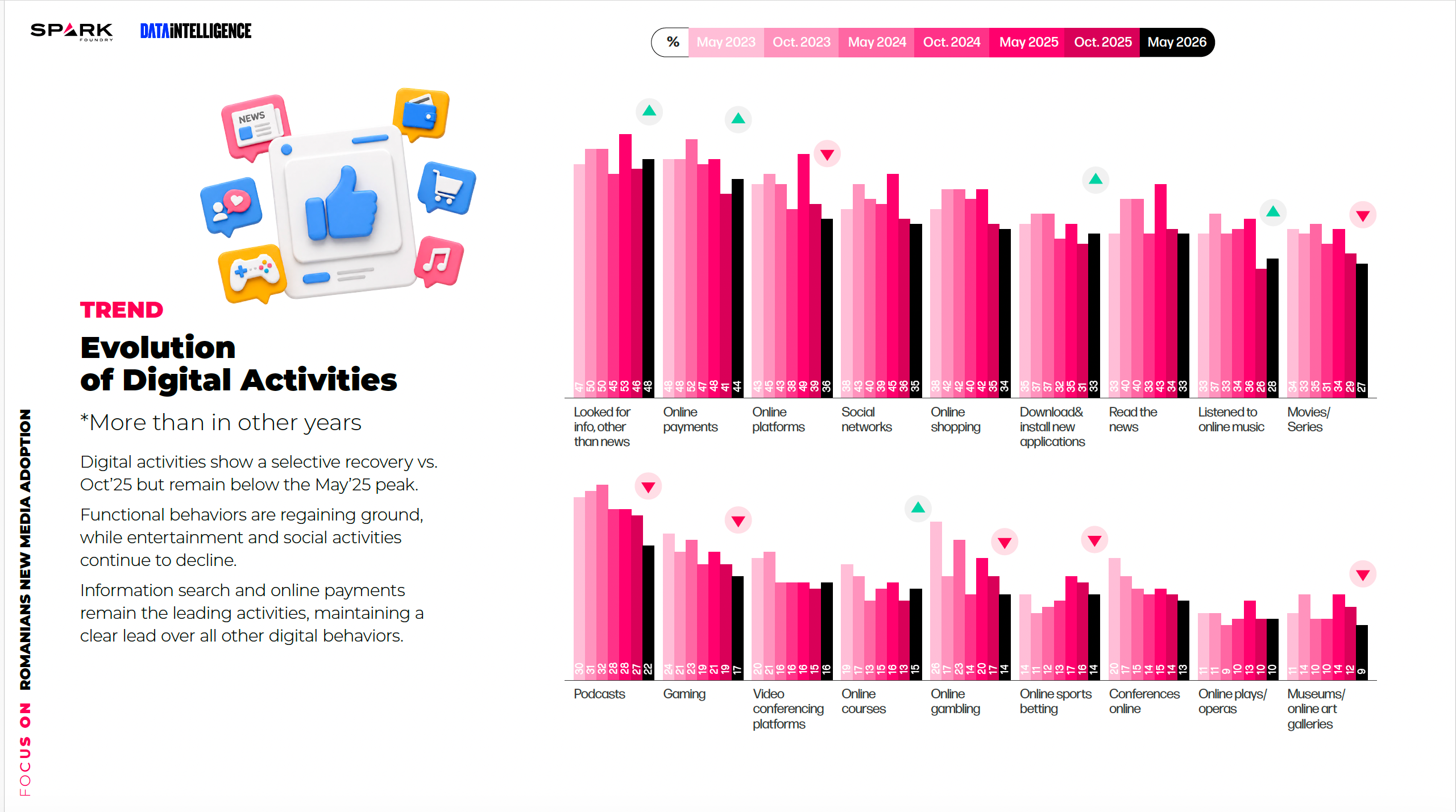
Two numbers moving in opposite directions tell the real story here: entertainment use of social media slipped from 38% to 35%, while product-information searches on social rose from 35% to 37%. People aren’t opening Instagram or TikTok to be entertained as much as they used to – they’re opening it to research something they’re about to buy. That’s a meaningful shift in intent, even if the platform and the session length look identical from the outside.
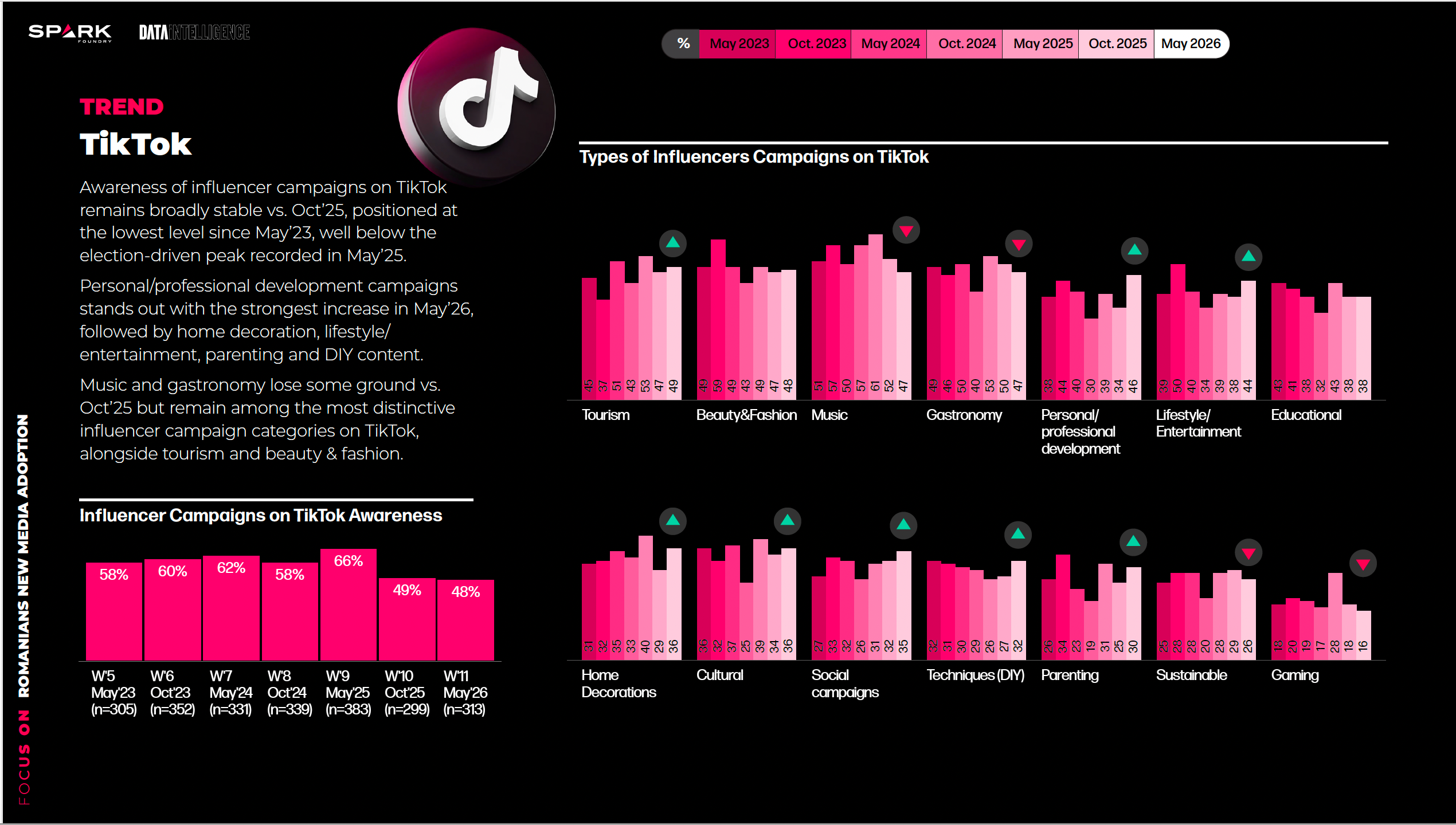
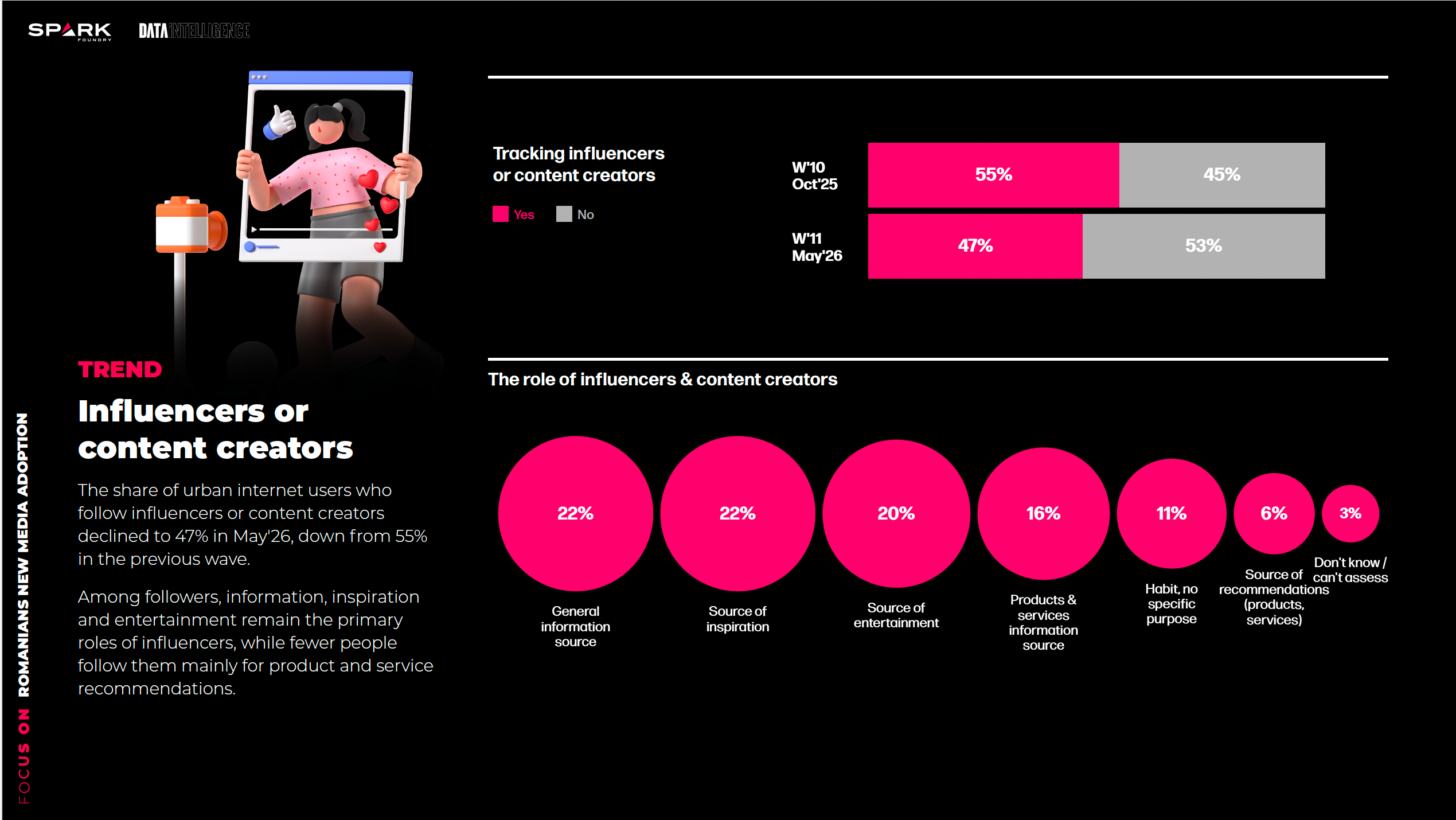
Meanwhile, trust in influencers has cooled at the surface but deepened underneath. The share of people who follow influencers or content creators at all dropped from 55% to 47% – a sharp pullback. But among those who still follow, the more active forms of engagement – creating response content, tagging creators, joining paid communities – all grew. Fewer people are watching from the sidelines; a smaller, more committed core is doing more.
And across every age group, one thing hasn’t moved: the source of information is, by a wide margin, still the top reason people decide to trust it – well ahead of production quality, tone, or popularity. Direct brand messaging remains the least trusted channel of all, trailing even opinions from strangers online.
None of this is a dramatic story. Nothing here is “disrupted” or “dead.” What’s happening is more like a slow redistribution of attention and trust across more channels, with AI arriving as a genuinely new layer rather than a replacement for the old ones. That’s harder to build a headline around – but it’s a far more accurate map for anyone actually spending a media budget in the second half of 2026.
The short version of the study is available for download. For the full report, contact contact@dataintelligence.ro. It explores how digital behavior is evolving across age groups – from shifting media habits and more information-led social media use, to the growing role of AI in search and everyday decisions. It also looks at the gap between Smart TV reach and attention, and why source credibility matters more than brand claims.


Methodology
The study was conducted by the Data Intelligence team of the media agency Spark Foundry, using the CAWI (Computer Assisted Web Interviews) method, on a sample of 808 male and female internet users aged 18 and older, living in urban areas, during the period of May 26-31, 2026.
All Publicis Groupe Romania proprietary data tools in one place.