Focus ON – Romanians’ Media Reset: Insights from the 10th wave
19 Dec 2025
 Search


 All Publicis Groupe Romania proprietary data tools in one place.


For years, we’ve been telling ourselves the same story: digital wins, TV fades, social sells, influencers convert, and attention keeps getting shorter.
But 2025 is quietly rewriting that script.
Looking at the latest, the anniversary 10th wave of Focus ON – Romanians New Media Adoption study, conducted by Spark Foundry Romania, something surprising is happening under the surface: people are pulling back. From platforms. From constant interaction. From endless content. And they’re doing it in ways that matter deeply for brands and marketers.
“If in May 2025 public attention was strongly oriented toward digital media and online communities, driven by the presidential elections and international tensions, today we are observing a significant rebalancing: a gradual return to traditional sources of information, alongside declining engagement in online activities and on social platforms. This shift can be explained by the normalization of the political context, as well as by a growing need for security and information verification.
In addition, while the adoption of artificial intelligence continues to increase, users are becoming more selective and more cautious toward automatically generated content, reflecting a maturing digital behavior.” stated Mădălina Bâdea, Head of Data Insights, Spark Foundry.
Let’s unpack what’s changing, and why your strategy should change with it.
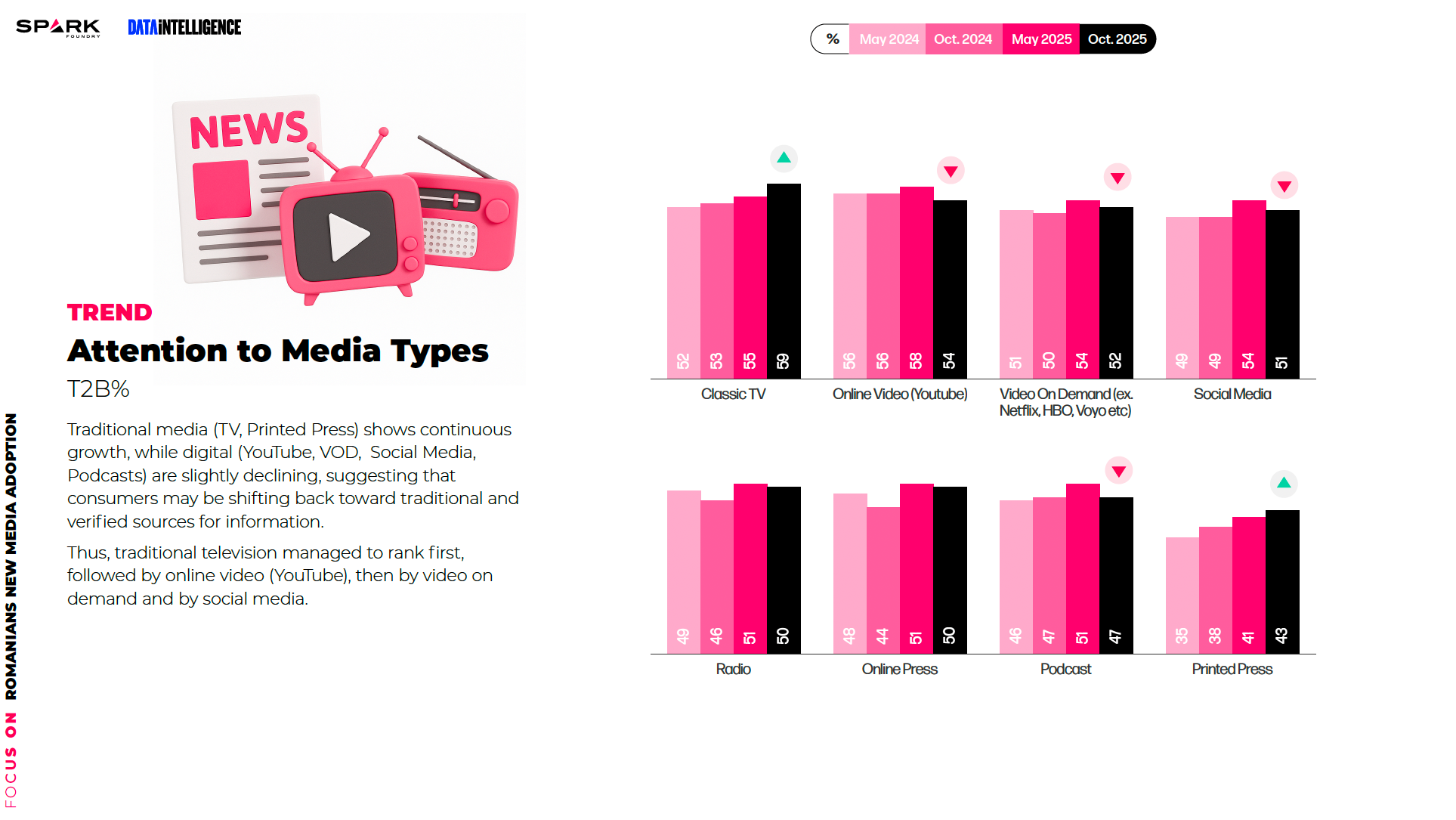
Yes, you read that right. Attention toward traditional media (TV, radio, print) is growing, while attention toward digital channels (YouTube, VOD, social media, podcasts) is slowly declining. Classic TV is back in the top spot for attention, ahead of YouTube and streaming.
And it’s not because people suddenly miss the past. In an environment overloaded with content, misinformation, and performance pressure, people are gravitating back to familiar formats, verified sources, and predictable experiences.
What this means for business: if your media plan is built on “digital first, everything else second,” you may be missing valuable attention. Credibility is becoming just as important as reach.
People still say they trust information because of the source, but fewer and fewer actively think about why they trust something. More respondents simply say: “I didn’t really think about it.”
That means trust is becoming more passive, which also means it’s more fragile. People respond strongly to how information is presented, the tone used, the sense of clarity and professionalism.
Why it matters: brands that don’t actively build reliability and clarity risk blending into the noise. Trust isn’t lost through big mistakes anymore; it’s lost through small absences.
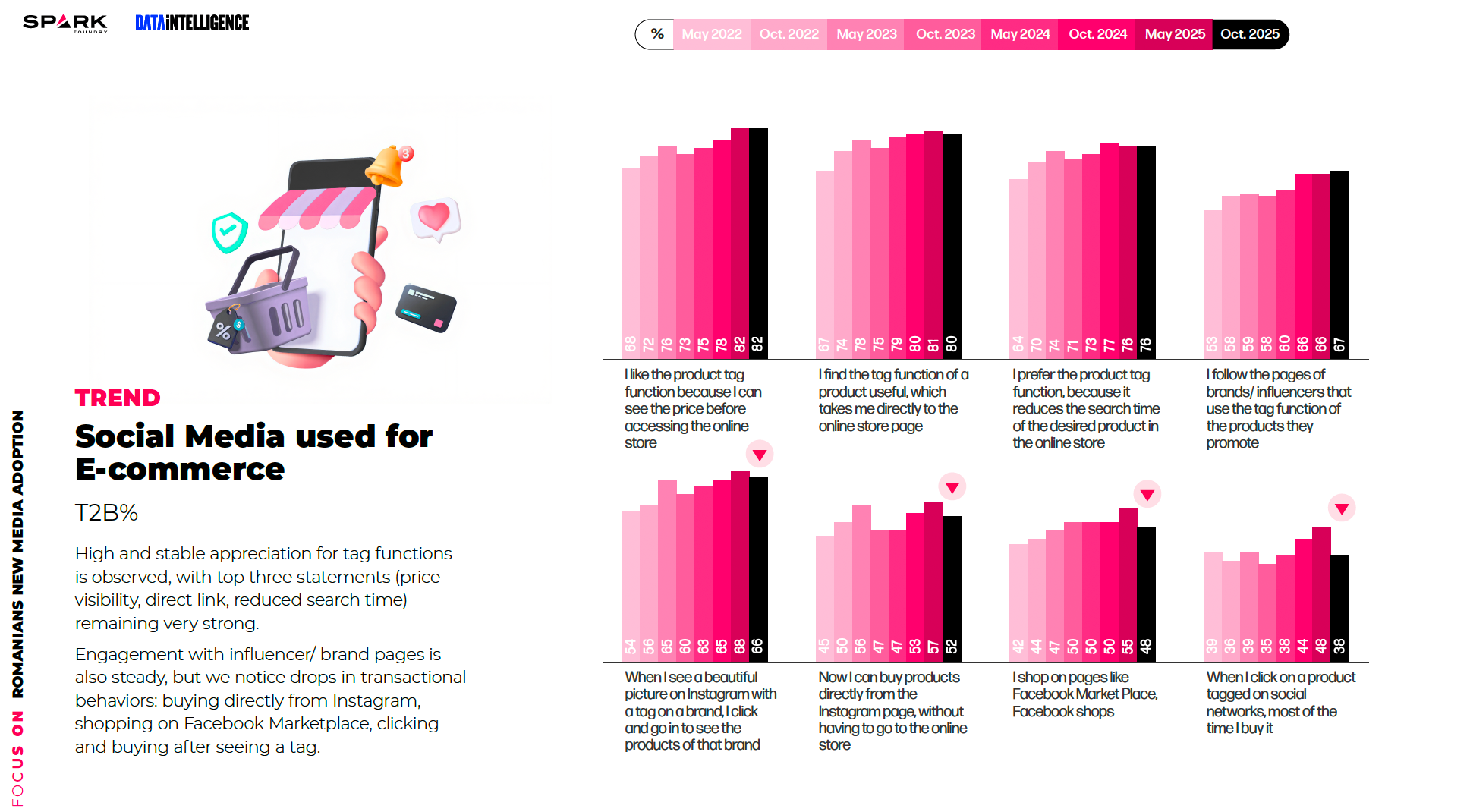
Social platforms are losing momentum across the board: less usage, less shopping behavior, less content interaction. The only motivation that’s growing? Staying connected with friends.
Shopping-related behavior on social media has dropped back to 2024 levels. People still follow brands, but they’re buying less directly from platforms. Meanwhile Facebook remains solid, Instagram and TikTok are declining, TikTok is nearing its 2023 usage levels again.
What this tells us: social media is becoming less transactional and more relational. It’s no longer the universal sales engine many strategies still treat it as. If your social strategy is still designed primarily to “convert,” it’s misaligned with how people now use these platforms.
People now overwhelmingly prefer under 1 minute, or 1–5 minutes for online video. Anything over 10 minutes is rapidly losing ground. Today’s audience has zero patience for filler. They want value from the first seconds, a clear message, content that respects their time. Long-form only works when there’s strong intent. Everything else must earn attention in seconds.
Second-screen behavior while watching TV has dropped by half. That’s huge.
Less scrolling, less searching, less commenting, less multitasking during shows. People are either watching properly or not watching at all.
Why this matters: The classic “TV + social amplification” model is weakening. Real-time buzz is no longer guaranteed. Attention is more sequential, not simultaneous. Campaigns need to think in journeys, not moments.
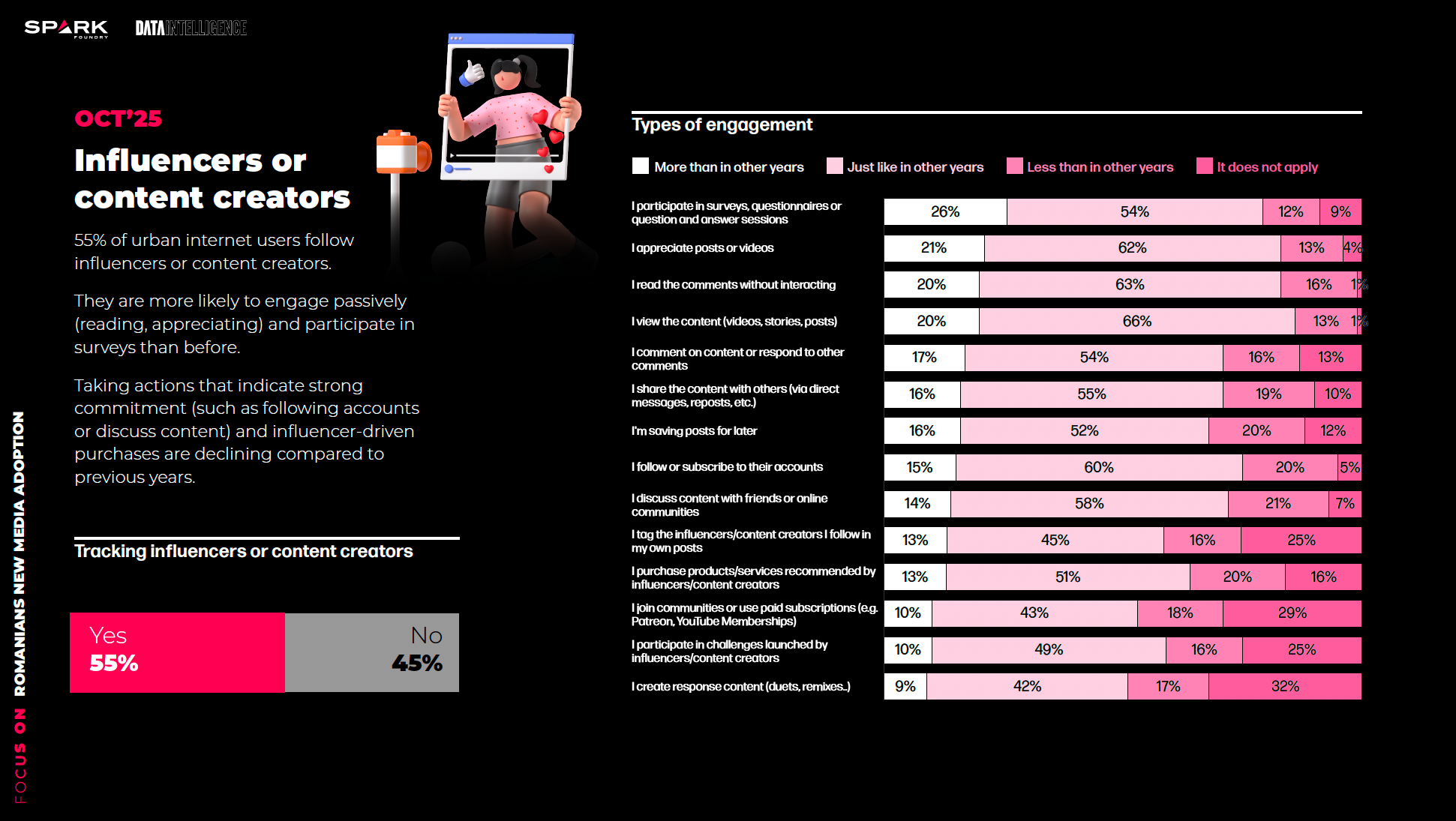
More than half of urban users still follow influencers. So, at first glance, nothing seems broken. Until you look closer: passive engagement is up (likes, views), but active behaviors are down for following brands, discussing content, buying based on influencers. On TikTok, awareness of influencer campaigns fell to its lowest level ever. Music, beauty, gastronomy and tourism still cut through, but most other categories are losing memorability.
The uncomfortable truth: influencers are becoming media, not salespeople. If you still expect them to drive the same conversion impact as before, your key performance indicators are outdated.
AI adoption is growing fast: 56% of urban users now use AI, mostly for chat, image generation, document analysis. But here’s the tension:
Implication for brands: AI is great for becoming operationally essential, but people still want to know where the human layer is. Transparency and editorial judgment matter more than ever.
Once-booming behaviors are all declining: podcasts are back to 2023 levels, live streaming is falling across every category (music, gaming, education), gaming activity is decreasing, especially on smartphones.
The pandemic-era spike is clearly over. People are moving from exploration to selectivity. Utility now trumps experimentation.
Almost 9 in 10 urban users own a Smart TV. What’s changing is how they use it:
Meanwhile, classic TV advertising exposure is declining slightly, but ads in online video and app menus remain stable.
The message: premium environments are back in fashion. And with them, the logic of brand safety, quality reach, and controlled experiences.
Here’s one of the most interesting under-the-radar signals. People are increasingly open to local events, proximity-based activations, and brand moments happening offline, promoted online.
Digital triggers the interest, but the value is delivered in the physical world. This opens space again for retail media, geo-targeted campaigns, local partnerships, experiential activations.
2025 is not the year of “the next big platform”; it’s the year people rethink their relationship with media and content. We’re seeing a move toward more selectivity, more protection of attention, less interest in noise, more interest in trust, comfort, and value. Digital isn’t disappearing, but it’s no longer expanding blindly. It’s consolidating.
The winners of the next phase will be the most intentional, those who will:
For years, growth meant more: more channels, more content, more exposure. In 2025, growth looks a lot more like better choices. And that might be the most valuable reset the market could have asked for.
The short version of the study is available for download.
For full insights, reach out at contact@dataintelligence.ro. The study explores age-driven differences in media consumption, adoption of AI chat features, perceptions of AI-generated visuals, news engagement patterns, and trust drivers, providing a clearer picture of how digital behaviors are evolving today.


Methodology
The study was conducted by the Data Intelligence team of the media agency Spark Foundry, using the CAWI (Computer Assisted Web Interviews) method, on a sample of 802 male and female internet users aged 18 and older, living in urban areas, during the period of October 24-29, 2025.
All Publicis Groupe Romania proprietary data tools in one place.